Eco WPC Inspection Tests For Weather-Ready Outdoor Product Quality
Inspection Standards for Eco WPC Outdoor Products
International buyers of outdoor WPC products need more than an attractive board sample. They need evidence that the material will retain its strength, appearance and dimensional stability after years of sunlight, rain, temperature changes and daily use. Eco WPC inspection tests provide that evidence by connecting raw material control with finished product performance. A dependable manufacturer should define test methods for each production stage, record measurable results and maintain traceability from wood fibre and polymer batches through to packed goods.
Quality requirements vary according to the application. A decking board must resist foot traffic, moisture and surface wear, while a fence panel, pergola component or outdoor cladding profile may require stronger checks on wind load, screw retention and colour consistency. Buyers should therefore review a product specification that identifies material composition, profile dimensions, tolerances, surface treatment, recommended installation conditions and relevant test standards. Clear documentation helps importers, architects and project contractors compare suppliers on performance rather than price alone.
Raw Material and Formula Control
The consistency of eco WPC begins with the formulation. Wood flour or natural fibre should be checked for moisture content, particle size, cleanliness and fibre distribution. Excess moisture can create voids, surface defects and unstable extrusion. Recycled polymer must also be assessed for contamination, melt behaviour and batch consistency. Additives such as pigments, coupling agents, lubricants, UV stabilisers and preservatives require controlled dosing because small formulation changes can affect colour, impact resistance and weathering performance.
Before extrusion, the quality control team should verify the formula against an approved production sheet. Laboratory checks may include moisture analysis, melt flow testing, ash content, density and a small-scale blend evaluation. These records help identify whether a defect originates in raw materials, compounding or processing. For international OEM projects, retained samples from every material batch give both the manufacturer and buyer a reliable reference for future production and after-sales investigation.
Mechanical Tests for Outdoor Service
Mechanical inspection confirms whether an eco WPC profile can withstand its intended load. Bending strength and modulus testing indicate how a decking board behaves between joists, while impact testing reveals resistance to dropped tools, furniture movement and accidental knocks. Screw withdrawal and fastener holding tests are particularly important for fences, railings and cladding systems, where poor retention may lead to movement or failure during installation.
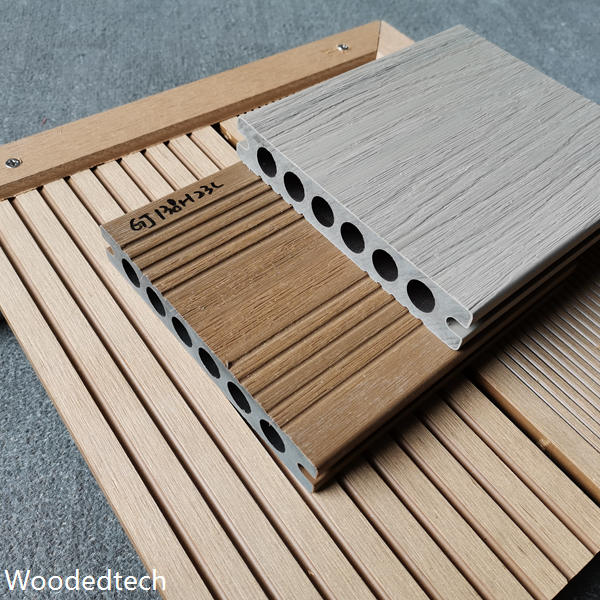
Dimensional checks should cover width, thickness, length, straightness, weight per metre and profile geometry. A calibrated gauge can identify warping, twisting or excessive tolerance before shipment. Surface hardness and abrasion testing are useful for decking used in commercial gardens, balconies and hospitality areas. Manufacturers should test finished products at a defined conditioning temperature and humidity, then report results with the sample direction, test duration and acceptance limit. This makes laboratory data meaningful for engineering decisions.
Weathering, Water and Thermal Resistance
Outdoor WPC quality depends heavily on resistance to environmental exposure. Accelerated ultraviolet weathering tests can assess colour change, chalking, cracking and surface degradation after controlled cycles of UV radiation, condensation and spray. These results should be interpreted alongside natural exposure data where available, because climate, orientation and maintenance influence real service life. A good supplier states the expected colour variation clearly instead of promising that the surface will remain unchanged.
Water absorption and thickness swelling tests show how the product responds to repeated wetting and drying. Low absorption generally supports better dimensional stability, although profile design and surface structure also matter. Freeze thaw cycling is relevant for buyers in northern Europe and other cold regions, while heat ageing helps evaluate performance in high temperature climates. Thermal expansion data should be included in installation guidance so that installers can set correct board gaps, fastening points and end clearances.
Surface Quality, Safety and Export Release
Visual inspection remains necessary even after laboratory testing. Inspectors should examine colour uniformity, embossing, co-extruded layers, edge condition, scratches, bubbles, exposed fibres and contamination under controlled lighting. Each production run should be compared with an approved master sample. For products used around homes, schools, hotels and public spaces, slip resistance, splinter behaviour and surface temperature may also require review. Fire performance and chemical resistance should be assessed according to the destination market and project specification.
Before loading, the quality inspection supervisor should confirm test records, pallet labels, quantities, packaging strength and product identification. Packaging must protect corners and surfaces from abrasion while allowing ventilation where moisture could accumulate. Export documents should match the tested product, including colour, profile code, batch number and declared dimensions. This disciplined release process reduces disputes, supports dependable installation and gives international customers confidence that each shipment of eco WPC is prepared for demanding outdoor service.